Green Basilisk

Commonly found in the tropical rainforests of Central America. They have an omnivorous diet, eating invertebrates and mice as well as an occasional fruit.
These lizards are beginner friendly due to their size. Usually growing up to 3 feet long, they aren’t very stocky and are very light for their length.
They require higher-than-normal temperatures and humidity with a large enclosure. They don’t always adapt well to handling, but make an entertaining pet lizard for those looking to admire from afar.
This species is best kept by beginners who are ready to accommodate their specific husbandry requirements and lack of human interaction. They live 8-12 years and cost $25-$65 USD.
Caiman Lizard

The Caiman is great for first-time keepers looking for a unique color pattern. This species has heavy scales with all the colors of the rainbow.
They are also great climbers and swimmers which makes them active in their vivarium.
Caiman Lizards are very big, one of the biggest on this list! They can reach 2-5 feet long and will need an enclosure that is big and strong enough to house them properly. Because they love to swim, they will also need a very big pool of water to submerge in.
These reptiles also prefer it very hot in their enclosure (with a high humidity too).
They mostly eat a carnivorous diet, eating invertebrates found in marshy areas, including insects, snails, crawfish, and clams.
Caiman Lizards are smart and are not naturally aggressive, but they don’t always adapt to being handled well. They make a great beginner lizard for someone willing to house and care for them from a distance, enjoying their beautiful rainbow appearance.
They live up to 10 years and are a bit expensive with prices reaching $350-$900 USD.
Gidgee Skink

Gidgee Skinks are unique because they are often found in groups rather than living alone.
These Australian natives are between 7-10 inches in size and need a tank size of around 40 gallons. They require much higher temperatures than is usually required for reptiles, with a basking area of up to 120℉!
They are omnivores and eat a variety of insects and vegetables. They are relatively fast-moving in and outside of their tank, so they don’t always do well with handling.
Gidgee Skinks make a good pet Lizard for beginners who want a group of unique-looking reptiles who are active in their tank.
They can live for more than 20 years, and are very expensive reaching $550-$2000.
Green Iguana

Iguanas are very popular beginner Lizards because of their beautiful appearance and herbivore diet. They eat leaves, fruits, and flowers, and so they make great first-time reptiles for anyone who doesn’t enjoy feeding live food.
They are native to Central and South America and they grow to 5-6 feet. Because they get very big they will need a large enclosure with a pool of water large enough to soak in.
Iguanas can be shy. If you plan on getting an Iguana, make sure they adjust to being in your home before you handle them.
Once they seem more comfortable, you need to start handling your Iguana as often and gently as possible to tame them.
They also have sharp claws, so just be aware of where their feet are.
Iguanas live 10-15 years and cost $20 to $50 as babies or juveniles.
They make a great choice for beginners with plenty of space, patience, and dedication.
African Fire Skink

Unsurprisingly, as their name suggests, the African Fire Skink is found in Africa and are known for their bright red colors!
They are not large lizards, reaching only 14-15 inches in length, and have very basic husbandry requirements. They don’t require any specific heating or lighting but do need a substrate that they can dig into. They eat mostly insects but can occasionally have a pinky mouse.
African Fire Skinks are usually very shy, but they have great personalities and activity levels when admired from far-away.
Overall, this is a hardy lizard who lives for 15-20 years with few health problems. What makes them uncommon is their availability; they aren’t easy to find at local pet stores. They cost $25-$70.
They make great beginner reptiles because they live easily with few problems and are full of energy and personality.
Gargoyle Gecko

Gargoyle Geckos are closely related to the extremely popular Crested Gecko and also come from New Caledonia.
They resemble the Crested Gecko with their large, slitted-eyes, but lack the spiny eyelashes which Crested Geckos are so well-known for.
With similar care and husbandry requirements as the Crested Gecko (e.g. basic tank, heating and lighting), they are only less popular due to their timid and shy temperament. They will likely try to escape when being handled.
While they have very easy care requirements, first time owners should adopt this lizard if they enjoy their appearance but aren’t looking to handle them frequently.
They are of similar size to Crested Geckos, reaching a maximum of 8 inches, will live for 10-15 years and generally cost $50-$100.
Despite a Gargoyle’s shy nature, they are easy to care for and make a good choice for beginners who don’t want the more popular Crested or Leopard Geckos!
Savannah Monitor

The first Monitor on our list, the Savannah is a less popular choice when it comes to monitors, as they are a bit bigger and can be less docile than the Ackies Monitor (#11 on our list). This does not mean, however, that they do not make a good beginner lizard.
These African savannah natives are large pets, but like the Ackies, are still smaller than other monitors, reaching 2.5-3 feet long.
They require housing large enough to accommodate their large size. Being both strong and smart, their enclosure needs to be well built to keep them from escaping. These reptiles also like to dig, so they will need a substrate that allows for this.
Savannah Monitors eat mice, insects and other invertebrates.
Like the Ackies Monitor, the Savannah is one of the more easily tamable monitors, and they can become very docile with regular, gentle handling. They tend to live 15-20 years and cost $30-$40.
Their docility makes them a great pet for a beginner who wants a larger lizard.
Long-Tailed Lizard

The Long-Tailed Lizard, also known as the Asian Grass Lizard, has a tail that is 3 times the length of its body.
This Asian lizard, despite its tail’s length, is very small. They have a slender, small body and only grow to 8 inches in size from snout to vent.
They may not be very big, but they should have a 20-gallon tank to accommodate their tail length, fast movements, and high energy levels. They need lots of leaves and branches in their enclosure, as their habitat in the wild is most commonly trees and forgery!
Naturally gentle and easy-going, they are the perfect pet lizard for beginners looking to keep a small species in a well-decorated tank.
Long-Tailed Lizards only live 5-6 years in captivity, but they are also pretty inexpensive ($5-$15).
Chameleon

Even if you aren’t a herpetologist, you may still recognize the Chameleon for a variety of reasons:
- Their famous color-changing abilities.
- Their telescopic eyes.
- Their claws and slow movements.
Though popular as pets, they do not always have the best time adjusting to life in captivity. These pets require lots of special care to help them feel safe in captivity.
Many beginners take on the responsibility of housing Chameleons, but they must understand the responsibility of caring for an easily stressed species.
Chameleons make beautiful and entertaining display reptiles for beginners.
They are native to Africa, but like many species, are rapidly disappearing with deforestation. Many in the pet trade are wild-caught, and so should be avoided by beginners.
Chameleons are not aggressive to their owners, but are extremely shy and have little in the ways of defending themselves. Any handling stresses them.
They vary widely in their size, depending on the species, ranging from 1 inch. to 27 inches. They only live for 2 years in captivity and can cost $30-$300.
For some beginner hobbyists, they can make a good first pet because of their docile nature. However, they are much harder to care for than other reptiles on this list.
Ackies Monitor

The Ackies Monitor is naturally found in Australia and looks like a small Komodo Dragon.
They are known for their spines on their tail which they use to protect themselves from predators. They have a carnivorous diet that includes mostly insects and the occasional pinky mouse.
Ackies Monitors are very tame for first-time reptile keepers.
However, some potential owners are concerned by their large size. They are larger than most reptiles on this list, ranging from 24-30 inches long. But, they are smaller than most other monitors.
They are known to like their basking spots very hot, but their lighting and humidity requirements are relatively simple.
Monitors typically aren’t recommended for beginners, but the Ackies is tame and smaller than most. They do best with a room dedicated to just them and generally live 15-20 years, costing $250-$400.
Gold-Dust Day Gecko

The Gold-Dust Day Gecko is a native to Madagascar but has recently been introduced to some Pacific Islands, including Hawaii.
Mostly green in color, they earn their name from the gold specks that develop on their dorsal side.
They are a small lizard, averaging about 5 to 6 inches, but they should still have a 20-gallon tank with lots of logs and branches to hide in. This will accommodate their shy nature. These branches will also allow them to enjoy their love of climbing.
What keeps some beginner reptile keepers from adopting this species is that they stress very easily and their skin tears easily. These lizards do best as a display pets with limited handling.
They are suited to beginners who wish to learn about caring for a lizard without interacting with them very much. Gold-Dust Day Geckos live about 10 years and cost $40-$250.
Chinese Water Dragon

There are several species of water dragons; the most common for beginners are the Chinese and Australian water dragons. Chinese Water Dragons are typically more popular than Australians.
Water Dragons require large enclosures, closely regulated temperatures and a mostly insectivore diet, with some leafy vegetables. One thing that is more difficult about caring for a water dragon is that they require very high humidity.
Chinese variants are mostly green. Their care requirements can be more advanced:
- They need large tanks (e.g. 4 to 6 feet long) because they reach up to 3 feet in size.
- They enjoy swimming, so will need a large-sized pool of water within their enclosure to swim in.
Smaller than most water dragons, they must be socialized from an early age to become accustomed to handling. Once socialized, they are typically very friendly and enjoy handling.
They have an average lifespan of 15-20 years and cost $20-$80. If you are looking for an Australian Water Dragon, they are $200 to $300.
While they may have specific care and husbandry requirements, a beginner with the room and dedication can certainly care for a Chinese Water Dragon.
African Fat-Tailed Gecko

African Fat-Tailed Geckos are very similar to Leopard Geckos (who rank #2 on our list) and have very similar care requirements.
As their name suggests, these lizards are African natives and their tails are nearly as thick as their bodies.
Like Leopard Geckos, they are very easy for beginners to care for. They have very easy husbandry and feeding requirements. They are generally friendly and docile.
They live anywhere between 10 and 25 years and generally cost anywhere between $150 and $600. What puts them much lower on this list than their leopard cousin is their popularity, and thereby, their greater lack of availability.
Uromastyx

The Uromastyx is in the same family of lizards (“genus family”) that has Bearded Dragons. Native to the Middle East, they are solid yellow-gray in color and ground dwellers.
Uromastyx aren’t overly large in size, reaching 14-16 inches, but they are bulky and heavy.
They have simple husbandry requirements, but because they are diggers, they need a substrate that they can burrow into.
Known as Spiny-Tailed Lizards, they are nearly entirely herbivorous. They eat mostly vegetables, including leafy greens and grocery store vegetables, and they only eat insects every once a week.
When it comes to a beginner’s handling, Uromastyx are very docile and friendly.
Their overall temperament and ease of care make them a good beginner pet. They can live 15-30 years and generally cost $75-$300 depending on the species.
Argentine Black and White Tegu
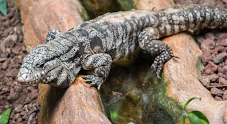
The Argentine Black and White Tegu is native to South America, but have recently been introduced to the wilderness of Florida. They are a burrowing species and like to hide in burrows to avoid extreme heat.
This is a larger species, reaching up to 4 feet in length, but beginners who can manage their size should have no trouble caring for them.
Despite their large size, Black and White Tegus tend to be more docile than most reptiles.
They can be handled readily and are very intelligent. They are another reptile species that eat mice, so this may not be the best option for you if you would rather feed fruit or insects!
This tegu lives for 15-20 years and generally costs $140-$400.
Green Anole

They are known by reptile hobbyists for extending their bright red dewlaps under their chin, as this greatly contrasts their bright green body.
Green Anoles are small lizards with long tails, so their housing does not need to take up a great amount of room in your house. A 20-gallon enclosure is more than big enough for them be comfortable. Anoles require the basic light, temperature, and humidity that many other pet lizards need.
These lizards are great for first-time owners because of their small size and relative ease of care. They do, however, require some live plants in their terrarium for hiding and licking dewdrops.
One disadvantage to this species as a first-time pet is that they prefer not to be handled consistently.
They have a very shy nature but may be willing to be handled if they are handled gently from a very young age.
Green Anoles are small, about 5-8 inches long, and have a shorter lifespan of three to six years. They tend to be very inexpensive, costing $10 or less.
In summary, this is a great reptile for beginners who want to learn how to care for a lizard but do not want to handle them much.
Blue-Tongue Skink

The Blue-Tongue Skink is best known for its bright blue tongue!
These Australia natives are omnivorous, eating mostly fruits with some meat. Although they need a fruit and vegetable diet, meat should also be provided, consisting of big worms or mice.
They are a bit heavier than previously listed reptiles, but they do not get very long for their weight (about 20 inches).
Blue-Tongue Skinks are generally very docile, quiet, and easily tamed. If they feel threatened, they do have a strong bite, so while it is ok for children to handle them, they should always be supervised.
This skink lives up to 20 years and generally cost $150-$250, but rarer morphs can cost thousands.
Overall, their ease of care and docility make them good beginner reptiles.
Crested Gecko

The Crested Gecko is native to New Caledonia (a group of islands near Australia). These geckos are well-known for having “eyelashes.” These eyelashes are actually spines that travel from their eyes down to their tail.
Crested Geckos, like most geckos, have webbed feet and love to climb, so they will need a tall tank. They also need a warm environment and a very high humidity.
Because they are nocturnal, they do not require any special lighting, but giving them two to four hours of light each day is best for their natural circadian rhythm.
Like the Bearded Dragon, Crested Geckos are are very docile reptiles and are not likely to bite, making them easy to handle for those who are gentle with them.
Crested Geckos are small, growing up to 8 inches in length, and live for about 10 or more years. Their price varies depending on a variety of factors, but they typically fall between $30-$300.
Leopard Gecko

Leopard Geckos are very popular and are widely known for being a great pet for beginner herpetologists.
They are coated with a pattern of dark brown spots, much like the animal they are named after. They are entirely insectivorous and require calcium supplements. They are also nocturnal.
Leopard Geckos are generally very docile, not likely to bite, and their ease of care makes them suitable for beginners.
They like to vocalize, especially if they’re hungry, so they may not be the one if you don’t want a noisy pet.
Luckily, unlike other geckos, this species doesn’t have sticky toes and doesn’t climb, so they will not need a tall tank.
They are smaller than the Bearded Dragon, growing to a foot at most, and live about 10 years. They generally cost $20-$40, but rarer morphs can be more expensive.
Bearded Dragon

The Bearded Dragon is an all-round popular, outgoing, and easy-to-care-for lizard. They are one of the best reptile pets you can have.
Beardies are native to Australia, and are known for the way they communicate with each other. They have folds of skin under their chin that puff out in a “beard”.
Bearded Dragons are active during the day, and they are omnivorous, consuming a variety of fruits and insects. They eat a couple times a week and should also have a calcium supplement.
These dragons are as sociable as lizards get. Most of the time, they tend to enjoy interactions with their owners. Many owners have claimed that each dragon has its own little personality.
The Bearded Dragon’s overall ease of husbandry and friendly temperament make it a great beginner lizard. They grow 1-2 feet in length, live 10-15 years, and generally cost $30-$60 depending on their size.


 Northern ringneck
  Southern ringneck


 Indian leopard is one of the 8-9 valid leopard subspecies found
throughout the world. Known by the scientific name of Panthera pardus,
it is the fourth largest of the four 'big cats' of the Panthera genus.
At the same time, leopards are also the fifth largest of all cat
species. The name 'Leopard' has been derived from a combination of two
Greek and Latin words leo and pard, 'leo' meaning lion and 'pard'
meaning panther. This name was given to the animal since it was
initially believed to be crossbreed of a lion and a panther.
Indian leopard is one of the 8-9 valid leopard subspecies found
throughout the world. Known by the scientific name of Panthera pardus,
it is the fourth largest of the four 'big cats' of the Panthera genus.
At the same time, leopards are also the fifth largest of all cat
species. The name 'Leopard' has been derived from a combination of two
Greek and Latin words leo and pard, 'leo' meaning lion and 'pard'
meaning panther. This name was given to the animal since it was
initially believed to be crossbreed of a lion and a panther.


 The name 'Deer' is given to the ruminant mammals belonging to the family
Cervidae. They are one of the most beautiful creatures on this earth
and extend to approximately 34 species. Male deer, in India as well as
the world, are known as stags, harts, bucks or bulls, depending upon the
species to which they belong. While, the females are known as hinds,
does or cows. One can find deers widely distributed throughout the
world, including the Indian subcontinent. The only continents where deer
are not found are those of Antarctica and Australia.
The name 'Deer' is given to the ruminant mammals belonging to the family
Cervidae. They are one of the most beautiful creatures on this earth
and extend to approximately 34 species. Male deer, in India as well as
the world, are known as stags, harts, bucks or bulls, depending upon the
species to which they belong. While, the females are known as hinds,
does or cows. One can find deers widely distributed throughout the
world, including the Indian subcontinent. The only continents where deer
are not found are those of Antarctica and Australia.


 Hog
Deer is a subspecies of deer, found in the areas stretching from
Pakistan, through northern India, to mainland Southeast Asia. A
population of the hog deer was introduced in a number of countries,
including Australia, the United States and Sri Lanka.
Hog
Deer is a subspecies of deer, found in the areas stretching from
Pakistan, through northern India, to mainland Southeast Asia. A
population of the hog deer was introduced in a number of countries,
including Australia, the United States and Sri Lanka. Muntjac
Deer fall in the category of those deer that are shy and elusive. They
are also known by the name of Kakad deer or the Barking deer in India.
The reason for this name is their alarm call, which seems very much
similar to the barking of a dog. Indian Muntjac deer counts amongst the
ten subspecies of the Barking deer in the world.
Muntjac
Deer fall in the category of those deer that are shy and elusive. They
are also known by the name of Kakad deer or the Barking deer in India.
The reason for this name is their alarm call, which seems very much
similar to the barking of a dog. Indian Muntjac deer counts amongst the
ten subspecies of the Barking deer in the world. Musk
deer comprise of one of the most endangered deer species, not only in
the Indian subcontinent, but also in the whole world. They are
classified as a subfamily of the Cervidae and have four sub-species.
Musk
deer comprise of one of the most endangered deer species, not only in
the Indian subcontinent, but also in the whole world. They are
classified as a subfamily of the Cervidae and have four sub-species. Sambar
Deer are dark brown in color and attain a height of 102 cm to 160 cm
(40 to 63 inches). The weight of the sambar deer of India may touch 300
kg. There are chestnut marks on the rump as well as the underparts.
Sambhur deer of India also have beautiful manes. However, they are not
spotted by birth. The spots develop gradually after birth.
Sambar
Deer are dark brown in color and attain a height of 102 cm to 160 cm
(40 to 63 inches). The weight of the sambar deer of India may touch 300
kg. There are chestnut marks on the rump as well as the underparts.
Sambhur deer of India also have beautiful manes. However, they are not
spotted by birth. The spots develop gradually after birth. Swamp
Deer, also known as Barasingha, is one of the most vulnerable species
of deer of the Indian subcontinent as well as the world. Presently, one
can find them only in the protected sanctuaries of India. Known by the
scientific name of Cervus duvauceli, the swamp deep of India derives its
name, Barasingha, from its large antlers.
Swamp
Deer, also known as Barasingha, is one of the most vulnerable species
of deer of the Indian subcontinent as well as the world. Presently, one
can find them only in the protected sanctuaries of India. Known by the
scientific name of Cervus duvauceli, the swamp deep of India derives its
name, Barasingha, from its large antlers. The
camels found in India are the single-humped camels, also known as the
Dromedary camels. Long-curved neck, deep-narrow chest and a single hump
characterize the Indian camel. The hump is used by the camels as
reservoir of fatty tissues. In times of scarcity, the tissues are
metabolized and the camel receives energy. The size of the hump is not
the same in all the camels. It differs from one camel to another,
depending upon its nutritional state. In times of starvation, the hump
can get reduced to almost a non-existent size.
The
camels found in India are the single-humped camels, also known as the
Dromedary camels. Long-curved neck, deep-narrow chest and a single hump
characterize the Indian camel. The hump is used by the camels as
reservoir of fatty tissues. In times of scarcity, the tissues are
metabolized and the camel receives energy. The size of the hump is not
the same in all the camels. It differs from one camel to another,
depending upon its nutritional state. In times of starvation, the hump
can get reduced to almost a non-existent size. Indian
elephant, known with the scientific name of 'Elephas maximus indicus',
is a subspecies of the Asian Elephant. It is mainly found in the Indian
subcontinent, that to in the scrub forested areas. The other counties
where Asian elephants are found include Bangladesh, Bhutan, Borneo,
Cambodia, China, Laos, Malaysia, Myanmar, Nepal, Thailand, Sumatra, and
Vietnam. Since Indian elephants are very huge and can trample all other
creatures, they have no natural enemies. Even lions, hyenas, and tigers
attack only the very young elephants and not adults.
Indian
elephant, known with the scientific name of 'Elephas maximus indicus',
is a subspecies of the Asian Elephant. It is mainly found in the Indian
subcontinent, that to in the scrub forested areas. The other counties
where Asian elephants are found include Bangladesh, Bhutan, Borneo,
Cambodia, China, Laos, Malaysia, Myanmar, Nepal, Thailand, Sumatra, and
Vietnam. Since Indian elephants are very huge and can trample all other
creatures, they have no natural enemies. Even lions, hyenas, and tigers
attack only the very young elephants and not adults. Golden
Langur, or Gee's Golden Langur, is known by the scientific name of
Trachypithecus geei. An Old World monkey, it was first noticed by the
scientific community in the 1950s only. In the Indian subcontinent,
Golden langurs are found mainly in the foothills of the Himalayas, along
the Assam-Bhutan border. The langurs are considered to be sacred by the
Himalayan people. The coat of Indian golden langurs is covered with
rich golden to bright creamish hair. The face is black and they have a
very long tail, which may measure upto 50 cm in length.
Golden
Langur, or Gee's Golden Langur, is known by the scientific name of
Trachypithecus geei. An Old World monkey, it was first noticed by the
scientific community in the 1950s only. In the Indian subcontinent,
Golden langurs are found mainly in the foothills of the Himalayas, along
the Assam-Bhutan border. The langurs are considered to be sacred by the
Himalayan people. The coat of Indian golden langurs is covered with
rich golden to bright creamish hair. The face is black and they have a
very long tail, which may measure upto 50 cm in length. Hanuman
Langur is believed to be one of the Old World monkeys, belonging to the
Semnopithecus Genus. They comprise of 15 subspecies and are terrestrial
in nature. Earlier hanuman langurs were believed to comprise of a
single species. However, now they are recognized as seven distinct
species. Hanuman langur is also known by the name of Gray Langur,
Entellus Langur and Common Indian Langur.
Hanuman
Langur is believed to be one of the Old World monkeys, belonging to the
Semnopithecus Genus. They comprise of 15 subspecies and are terrestrial
in nature. Earlier hanuman langurs were believed to comprise of a
single species. However, now they are recognized as seven distinct
species. Hanuman langur is also known by the name of Gray Langur,
Entellus Langur and Common Indian Langur. Lion-tailed
Macaque is one of the subspecies of macaque, found only in the Western
Ghats of South India. Known by the scientific name of Macaca silenus, it
has life expectancy of 20 years in the wild and upto 30 years in
captivity. Lion-tailed macaques spend most of their time on trees and
are excellent swimmers.
Lion-tailed
Macaque is one of the subspecies of macaque, found only in the Western
Ghats of South India. Known by the scientific name of Macaca silenus, it
has life expectancy of 20 years in the wild and upto 30 years in
captivity. Lion-tailed macaques spend most of their time on trees and
are excellent swimmers. Long-tailed
macaque is also known by some other names, like the Crab-eating Macaque
or the Cynomolgus Monkey. It is an arboreal macaque, belonging to the
Macaca genus, and has the scientific name of Macaca fascicularis. A
native of the Southeast Asia, the Crab-eating macaque of India has also
been flown into outer space.
Long-tailed
macaque is also known by some other names, like the Crab-eating Macaque
or the Cynomolgus Monkey. It is an arboreal macaque, belonging to the
Macaca genus, and has the scientific name of Macaca fascicularis. A
native of the Southeast Asia, the Crab-eating macaque of India has also
been flown into outer space. Indian
Stump-tailed macaque, also known as Bear macaque, is known by the
scientific name of Macaca arctoides. It can reach upto a length of 70
cm, at the maximum, excluding the tail that may grow upto 8 cm in
length. Indian Stump-tailed macaques weigh 6 to 13 kg and may live as
long as 30 years.
Indian
Stump-tailed macaque, also known as Bear macaque, is known by the
scientific name of Macaca arctoides. It can reach upto a length of 70
cm, at the maximum, excluding the tail that may grow upto 8 cm in
length. Indian Stump-tailed macaques weigh 6 to 13 kg and may live as
long as 30 years. A
typical macaque, the Rhesus monkey of India is believed to be one of
the best species of the Old World monkeys. It is an excellent swimmer
and enjoys water. Rhesus macaques are quite comfortable around humans
and have the tendency to move from rural to urban areas in search of
easy food. The average lifespan of Rhesus macaques is approximately 15
years in the wild.
A
typical macaque, the Rhesus monkey of India is believed to be one of
the best species of the Old World monkeys. It is an excellent swimmer
and enjoys water. Rhesus macaques are quite comfortable around humans
and have the tendency to move from rural to urban areas in search of
easy food. The average lifespan of Rhesus macaques is approximately 15
years in the wild. Bonnet
Macaque, an Old World monkey, is also known by the scientific name of
Macaca radiata. Found only in India, it has been named so because of its
physical appearance. Indian Bonnet macaques have a cap-like whorl of
hair on their head, which radiates outward from the center. Since the
coil of hair resembles a hat, they have been named as Bonnet macaques.
Bonnet
Macaque, an Old World monkey, is also known by the scientific name of
Macaca radiata. Found only in India, it has been named so because of its
physical appearance. Indian Bonnet macaques have a cap-like whorl of
hair on their head, which radiates outward from the center. Since the
coil of hair resembles a hat, they have been named as Bonnet macaques. Assam
Macaque is a diurnal primate, which inhabits the regions stretching
from Nepal to Vietnam and Southern China. It is yellowish to dark brown
in color and has a hairless face. The color of the face is red in case
of adults. Assam Macaques are also known by the name of Himalayan
Macaque and Hill Monkeys in India.
Assam
Macaque is a diurnal primate, which inhabits the regions stretching
from Nepal to Vietnam and Southern China. It is yellowish to dark brown
in color and has a hairless face. The color of the face is red in case
of adults. Assam Macaques are also known by the name of Himalayan
Macaque and Hill Monkeys in India. Arunachal
Macaque, scientifically known as Macaca munzala, is a native primate of
Arunachal Pradesh state of northeastern India. It is called by the
local population as Munzala, meaning monkey of the deep forest.
Arunachal Macaques were discovered by the Indian scientists in the year
2004 only.
Arunachal
Macaque, scientifically known as Macaca munzala, is a native primate of
Arunachal Pradesh state of northeastern India. It is called by the
local population as Munzala, meaning monkey of the deep forest.
Arunachal Macaques were discovered by the Indian scientists in the year
2004 only. Red
panda is a beautiful animal, found in only some other countries of the
world, including the Indian subcontinent. Scientifically known as
Ailurus fulgens, it is slightly bigger than the domestic cat and founds a
mention in the list of endangered species. Indian red panda bear is
quite apt at climbing trees and is mainly herbivorous. It is also known
as the Red fox or the Common panda and is native to the Himalayan ranges
of India. A one of its kind animals, Red panda is believed to be a
living fossil. The only other fossil close to the panda is that of
Parailurus, which lived 3 to 4 million years ago. The lifespan of a Red
Panda may range from nine years to fourteen years.
Red
panda is a beautiful animal, found in only some other countries of the
world, including the Indian subcontinent. Scientifically known as
Ailurus fulgens, it is slightly bigger than the domestic cat and founds a
mention in the list of endangered species. Indian red panda bear is
quite apt at climbing trees and is mainly herbivorous. It is also known
as the Red fox or the Common panda and is native to the Himalayan ranges
of India. A one of its kind animals, Red panda is believed to be a
living fossil. The only other fossil close to the panda is that of
Parailurus, which lived 3 to 4 million years ago. The lifespan of a Red
Panda may range from nine years to fourteen years. Indian
Rhinoceros holds the distinction of being the fourth largest animal,
after the three elephant species. Known by the scientific name of
Rhinoceros unicornis, the animal is found in only two places in the
world, Assam (India) and Nepal. The Great Indian rhinoceros is a
brilliant swimmer and has an acute sense of smell and hearing. Its
maximum speed reaches 55 km/h, that to for a short period of time.
Indian
Rhinoceros holds the distinction of being the fourth largest animal,
after the three elephant species. Known by the scientific name of
Rhinoceros unicornis, the animal is found in only two places in the
world, Assam (India) and Nepal. The Great Indian rhinoceros is a
brilliant swimmer and has an acute sense of smell and hearing. Its
maximum speed reaches 55 km/h, that to for a short period of time. Striped
hyena belongs to the Hyaenidae family and is scientifically known as
Hyaena hyaena. Strongly related to the Brown hyena, it is basically a
solitary creature. The average lifespan of striped hyenas hovers
somewhere around 10 to 12 years in the wild. When kept in captivity,
they can live longer also.
Striped
hyena belongs to the Hyaenidae family and is scientifically known as
Hyaena hyaena. Strongly related to the Brown hyena, it is basically a
solitary creature. The average lifespan of striped hyenas hovers
somewhere around 10 to 12 years in the wild. When kept in captivity,
they can live longer also. Indian
wild ass, also known as khur, is one of the subspecies of wild ass
belonging to southern Asia. Its scientific name is Equus hemionus khur.
Wild ass of India has an average age of 20-25 years.
Indian
wild ass, also known as khur, is one of the subspecies of wild ass
belonging to southern Asia. Its scientific name is Equus hemionus khur.
Wild ass of India has an average age of 20-25 years. Wild
boar is considered to be the wild antecedent of the domestic pig of the
Indian subcontinent. It belongs to the Suidae biological family, which
also includes the Warthog and Bushpig of Africa, the Pygmy Hog of
northern India and the Babirusa of Indonesia. Indian wild boars are also
quite closely related to peccary or javelina of North, Central and
South America.
Wild
boar is considered to be the wild antecedent of the domestic pig of the
Indian subcontinent. It belongs to the Suidae biological family, which
also includes the Warthog and Bushpig of Africa, the Pygmy Hog of
northern India and the Babirusa of Indonesia. Indian wild boars are also
quite closely related to peccary or javelina of North, Central and
South America.